
In a rush? Schedule an Appointment
    Fetching local time...
    Anytime Capital
    Retail crypto program
    What a store earns
    The money question

    What a store actually earns per transaction

    Store owners ask this first and everyone else answers it last. Here is the arithmetic, out in the open: how crypto revenue is calculated, what it looks like at five realistic order sizes, and how it compares with the products already on your counter.

    Talk to our retail teamStore sign in
    • Percentage of the order, not a flat fee
    • No equipment cost to earn back
    • No monthly platform fee
    • Illustrative figures — your rate is in your agreement
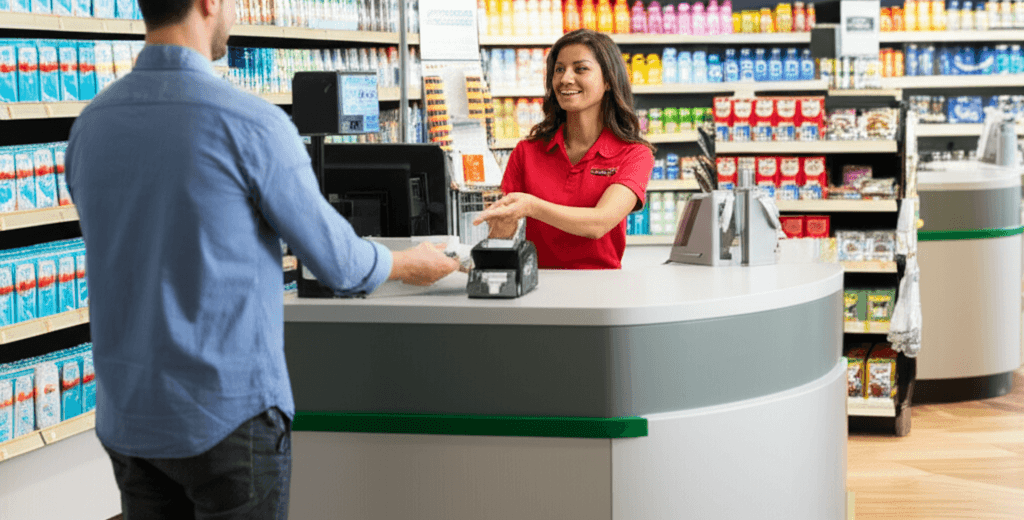
    A clerk serving a customer at a store cash counter

    $500.00

    A single order — and what the store keeps

    • Customer pays$500.00
    • Illustrative share1% – 3%

    How the revenue is calculated

    Crypto is sold at a percentage of the order value. Anytime Capital quotes the customer a rate, the customer accepts it, and the store that placed the order receives a share of that revenue. The share is set in your agent agreement, so this page cannot tell you your exact number. What it can show you is the shape of the arithmetic. That is what decides whether the product is worth your counter space.

    The important structural point is that the store's revenue moves with the size of the order. That is unusual on a check cashing counter, where most non-check products earn a flat fee regardless of ticket. A money order pays the same on a $50 order and a $900 order. A crypto sale does not.

    The figures below are worked examples at an illustrative 1% to 3% share. They are arithmetic, not projections, and Anytime Capital does not promise any level of income to any store.

    The arithmetic

    What a single transaction is worth to the store

    You keep a share of every order. Bigger order, bigger share. The examples below use 1% to 3% — your own rate is in your agreement.

    Illustrative store revenue by order size at a 1% to 3% revenue share
    At the counterOrder sizeStore keeps (low)Store keeps (high)
    A customer cashes a check and puts part of it into Bitcoin$200$2.00$6.00
    A regular buys USDT to send to family overseas$500$5.00$15.00
    A customer sells crypto and takes the cash$1,000$10.00$30.00
    A small business owner buys on payday, every other week$2,500$25.00$75.00
    One larger order, the kind an ATM's daily cap refuses$10,000$100.00$300.00

    The figures above are worked examples, not projected or guaranteed earnings. They show how the arithmetic works on a given order size at an illustrative revenue-share range. Your actual rate is set in your agent agreement, and what any individual store earns depends on its foot traffic, its neighbourhood, its hours and how many customers it serves. Anytime Capital does not promise any level of income.

    • A money order earns you cents. A wire earns a flat fee, however big it is. This does not.
    • No monthly fee. No minimum. Nothing to buy back before the first dollar is yours.
    • Your customer pays our normal published price. Your share does not change it.

    Against the rest of your counter

    How crypto revenue behaves compared with what you already sell

    The question is not whether crypto pays more per transaction in the abstract. It is how the revenue behaves as the ticket size changes — which is where flat-fee products stop keeping up.

    CriterionCrypto orderMoney orderBill paymentDomestic wire
    How the store's revenue is setA share of a percentage-priced orderA small flat feeA flat fee, often fixed by the billerA flat commission
    Does revenue grow with the ticket?Yes — directlyNoNoNo
    Capped by a state fee schedule?NoOftenOftenVaries
    Customer arrives already wanting itUsually — they have seen the kiosksYesYesYes
    Equipment the store must fundNoneStock and printerTerminalTerminal
    Repeat frequencyPayday, and the 1st and 15thOccasionalMonthlyOccasional
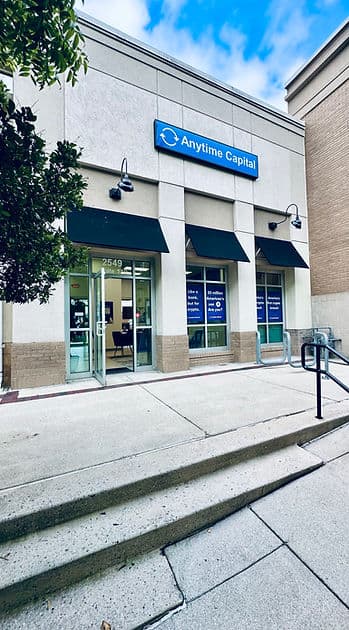
    The Anytime Capital branch storefront in Atlanta
    A real branch, not a kiosk
    A clerk serving a customer at a store cash counter
    Served at the counter
    The seating area and service counter inside an Anytime Capital branch
    Staffed, in person

    Anytime Capital runs its own branches in Atlanta and Miami. Partner stores run the same counter service.

    Why a single $500 order beats a morning of money orders

    Run the two side by side. On an illustrative 2% share, one $500 crypto order returns about ten dollars to the store. To match that on money orders at typical margins a cashier would need to write a great many of them, each with its own queue time, its own stock and its own paperwork.

    That is not an argument for dropping money orders. It is an argument about what the marginal minute of counter time is worth. Both transactions take roughly the same amount of your cashier's attention; one of them scales with the customer's wallet and the other does not.

    It also explains why crypto volume tends to concentrate. A handful of regulars placing larger orders on payday will, in most stores, out-earn a much larger number of small one-off transactions.

    What determines the number for your store

    Three variables do most of the work. The first is foot traffic — how many people cross your counter in a week. The second is average ticket, which is largely a function of your neighbourhood and whether your customers are buying with pocket money or with a cashed paycheck. The third is repeat rate, which is the one stores control most directly: a customer who is verified once and served well comes back on the next payday.

    What does not determine it is how much crypto your staff know, how prominent your signage is, or whether you have a machine. Stores that do well at this do well because their regulars found out they can do it, told each other, and came back.

    Everything else — no equipment cost, no monthly fee, no inventory, no float — matters mainly because it means there is no break-even to reach. The first order is profitable.

    Read the detail(1 section)+

    How to think about it against a kiosk placement

    A Bitcoin ATM placement pays a store a share of the machine's fees. Whether that beats a counter service depends on volume and on the terms in the placement agreement, and there are sites where a machine genuinely makes sense — a 24-hour location with space to spare and staff who do not want to be involved.

    But the comparison is not just revenue per transaction. A kiosk brings a footprint, a power draw, a landlord conversation, a service call when it jams, daily limits that turn away your largest customers, and a customer experience your staff cannot influence when it goes wrong. A counter service brings none of those, and it lets every employee on shift serve a crypto customer at once instead of queueing them at one box in the corner.

    The comparison page sets the two arrangements out line by line if you are weighing an offer that is already on your desk.

    Next

    Once the numbers make sense

    The two things store owners check before they say yes.

    The counter flow

    Exactly what your cashier does, step by step.

    Licensing and compliance

    Who carries the MSB registration and what the store is responsible for.

    Versus a Bitcoin ATM

    If a kiosk operator has already made you an offer.

    For money transfer agents

    The same decision you made about Western Union.

    Frequently Asked Questions

    What is the actual revenue share?

    It is set in your agent agreement, because it varies with market, volume and the services a location offers. This page uses an illustrative 1% to 3% band to show how the arithmetic behaves. Ask the retail team for the number that would apply to your store.

    Does the store's share change what my customer pays?

    No. Customers pay Anytime Capital's published rates, which are set out on the fees and limits page. Your cashier shows the customer the quote before the order is placed.

    Are there fees the store pays?

    There is no platform fee charged to the store and no equipment to buy or lease. If any market-specific charges apply, they are stated in the agent agreement rather than hidden in a schedule.

    How is the store paid?

    The revenue share is recorded against each order and settled on the schedule in your agreement. It appears in your store reporting, so you can reconcile it order by order rather than trusting a monthly total.

    Is there a minimum volume to stay in the program?

    Any minimums that apply to a particular market are set out in the agent agreement. There is no equipment cost to recover, so a low-volume month does not put a store in the red.

    How much do Bitcoin ATM hosts make by comparison?

    Kiosk placement terms are private, vary by operator and site, and are usually a share of the machine's fee revenue. We are not going to publish someone else's commercial terms. What we can say is what the two arrangements ask of the store, which the comparison page sets out line by line.

    Can you guarantee what my store will earn?

    No, and you should be wary of anyone who does. Earnings depend on your foot traffic, your neighbourhood, your hours and how many customers you serve. Everything on this page is arithmetic you can check, not a projection.

    Run the numbers against your own Friday

    Tell us your foot traffic and your neighbourhood and we will work through what the product realistically looks like at your counter.

    Talk to our retail teamStore sign in
    Anytime Capital

    Branches

    • Atlanta, Georgia
    • Miami, Florida

    Business

    • Business Checking
    • Business Debit Cards
    • Payments
    • Invoicing
    • Bill Pay
    • Expense Management
    • Sell Crypto in Your Store
    • Crypto for Check Cashers

    Solutions

    • CPAs & Accountants
    • Financial Advisors
    • Boat & Auto Dealerships
    • Dental & Medical Practices
    • Creators & Coaches
    • All solutions

    Crypto

    • Crypto Wallets
    • Tether Wallet
    • Buy Digital Assets
    • Buy with Your Bank Card
    • Blockchain Networks
    • Markets
    • Security & Licenses

    Company

    • Our Story
    • Schedule Appointment
    • Careers
    • Media & Press
    • Investor Relations
    • FAQ

    Legal

    • Terms & Conditions
    • Privacy Policy
    • Fraud Notice

    © 2026 Anytime Capital is a financial technology company, not a bank. Banking services provided by Pathward N.A. Member FDIC. The Anytime Capital Mastercard® Prepaid Card is issued by Pathward®, National Association. Mastercard® is a registered trademark. All other trademarks and service marks belong to their respective owners.

    This site is protected by reCAPTCHA and the Google Privacy Policy and Terms of Service apply.

    App StoreMastercard