Comparison
SWIFT code vs routing number: what's the difference?
Quick answer
A routing number is a nine-digit code that identifies a US bank for domestic payments; a SWIFT/BIC code is an 8- or 11-character code that identifies a bank internationally. Use the routing number for domestic wires, ACH, and direct deposit — use the SWIFT code when money crosses borders.
Updated October 2026. Evergreen page — refreshed in place as facts change.
- Routing number
- 9 digits
- US only; also called an ABA number
- SWIFT/BIC
- 8 or 11
- Characters; identifies a bank worldwide
- IBAN
- Up to 34
- Characters; identifies one account
- IBAN countries
- 89
- Using IBANs, as of late 2024
- Swift network
- 11,500+
- Member institutions worldwide
- US IBANs
- None
- Use SWIFT code plus account number
- Check digit
- 9th digit
- Validates the routing number
- Mexico's CLABE
- 18 digits
- Bank, city, account and check digit
SWIFT code vs routing number is a question of scope. A routing number finds a bank inside the United States; a SWIFT/BIC code finds a bank anywhere on the Swift network; and neither one identifies your account — that is the account number's job, or the IBAN's in the 89 countries that used IBANs as of late 2024. Mix them up and a payment bounces or, worse, stalls in a correspondent queue. This page decodes each identifier, shows which one each kind of payment needs, and covers the national codes — sort codes, CLABEs, IFSCs — that payments to those countries often still require.
Payment methods on this page

What is a routing number?
An ABA routing number is a nine-digit identifier assigned to US banks and credit unions for domestic payment routing — ACH transfers, direct deposit, checks, and domestic wires. It is a US-only system, and the digits are structured: the leading digits reflect the institution's Federal Reserve routing region, and the ninth is a check digit that validates the number mathematically.
Two practical wrinkles: large banks often use different routing numbers by state, and many banks use one routing number for ACH and a different one for incoming wires. When a form asks for 'the' routing number, match it to the payment type.
The check digit is why a mistyped routing number is usually caught at once. Multiply the digits by 3, 7 and 1 in a repeating pattern — 3 × (digits 1, 4 and 7) + 7 × (digits 2, 5 and 8) + (digits 3, 6 and 9) — and a valid number always gives a total divisible by 10. Most payment forms run that test before anything is sent, so most single-digit typos are rejected on the spot; a valid but wrong number is the dangerous case.
| Digits | What they identify |
|---|---|
| 1–4 | The Federal Reserve routing symbol: district and processing region |
| 5–8 | The institution's own identifier |
| 9 | Check digit that validates the other eight |
What is a SWIFT/BIC code?
A SWIFT code — formally a BIC, Business Identifier Code — identifies a bank on the international SWIFT messaging network. It is 8 or 11 characters with a fixed anatomy: four letters for the bank, two for the country, two for the location, and an optional three for a specific branch. DEUTDEFF, the example code in our own payout form, reads as DEUT (the bank), DE (Germany) and FF (Frankfurt).
Where a routing number tells US payment systems which bank to hit domestically, the SWIFT code answers the same question for the whole world — it is how a bank in Singapore addresses a payment message to a bank in Ohio. Swift, the cooperative that runs the network, connects more than 11,500 institutions in 200-plus countries and territories; it carries the payment instructions, and the money itself settles through accounts the banks hold with each other.
| Characters | Meaning | In DEUTDEFF |
|---|---|---|
| 1–4 | Bank code (letters) | DEUT |
| 5–6 | Country code (ISO letters) | DE — Germany |
| 7–8 | Location code | FF — Frankfurt |
| 9–11 (optional) | Branch code; XXX or blank means head office | Blank |
When do you use each one?
Match the identifier to the job:
| Task | What you need |
|---|---|
| Direct deposit or ACH transfer (US) | ABA routing number + account number |
| Domestic US wire | Wire routing number + account number |
| RTP or FedNow payment (US) | Routing number + account number, if both banks take part |
| Receiving money from abroad | Your bank's SWIFT/BIC + your account number |
| Sending money abroad | Recipient bank's SWIFT/BIC + their IBAN or account number |
| Paying a euro-area supplier by SEPA | IBAN (the BIC is optional within SEPA) |
| Paying a UK supplier by Faster Payments | Sort code + account number |
| Paying a Mexican supplier by SPEI | 18-digit CLABE |
| Paying a US bill by bank account | ABA routing number + account number |
Do you ever need both codes?
Regularly. To receive an international wire into a US account you hand the sender your bank's SWIFT code and your account number — and some banks' incoming-international instructions add a routing number for the final domestic leg. Fintech accounts often receive international payments through a partner bank's SWIFT code with special instructions, so check your provider's published receiving details rather than guessing.
Our routing numbers directory lists the ABA routing numbers, wire routing numbers, and SWIFT codes major US banks publish, in one place per bank.
Money from abroad into a US account
- 1
Sender's bank
Addresses the payment to your bank's SWIFT/BIC code.
BIC - 2
SWIFT message
Carries your name, account number and the reference.
ISO 20022 - 3
US correspondent
May hold the dollars and pass them on domestically.
Sometimes - 4
Domestic leg
Reaches your bank by its routing number, over Fedwire.
ABA - 5
Your account
Credited by account number and checked against your name.
Account no.
Where does an IBAN fit in?
An IBAN identifies a specific account — up to 34 characters including a country code and check digits — used across Europe and much of the world. The clean mental model: SWIFT/BIC identifies the bank, IBAN identifies the account at that bank. The US does not issue IBANs; a US account is identified by routing number plus account number domestically, and by SWIFT code plus account number from abroad.
So when an overseas form insists on an IBAN for your US account, it does not exist — the sender's bank will have a US-payment path that takes SWIFT plus account number instead.
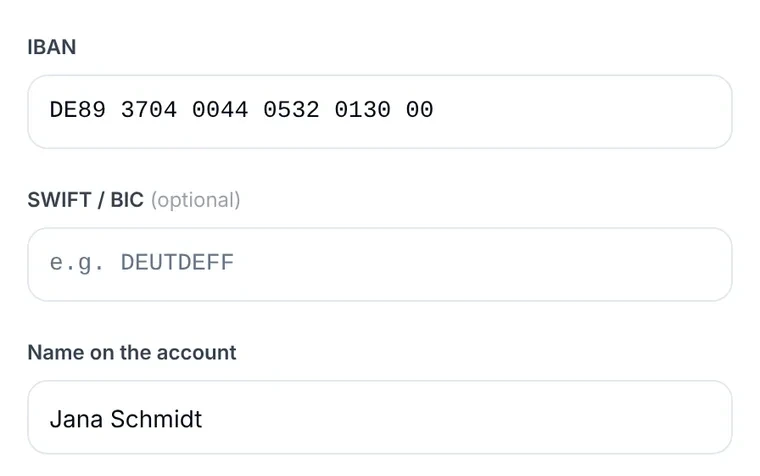
Read one and the structure is plain. A German IBAN such as DE89 3704 0044 0532 0130 00 is 22 characters: DE for the country, 89 as check digits that catch typos, then an 8-digit bank code and a 10-digit account number. Because the IBAN already contains the bank code, a euro payment inside SEPA needs only the IBAN — the BIC is optional.
What other bank codes will you meet abroad?
Many countries pair SWIFT for international wires with a national identifier for their own payment systems — and paying over those local systems usually needs only the national code. If you pay suppliers abroad, these are the formats you will meet most:
| Country | Identifier | Format | Local rail |
|---|---|---|---|
| United States | Routing number + account number | 9-digit routing number | ACH, Fedwire, RTP, FedNow |
| Euro area | IBAN | Up to 34 characters (22 in Germany) | SEPA, SEPA Instant |
| United Kingdom | Sort code + account number | 6 digits + 8 digits | Faster Payments |
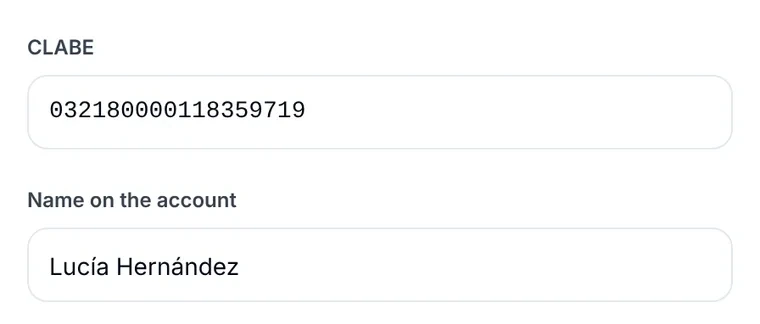
| Mexico | CLABE | 18 digits | SPEI |
| India | IFSC + account number, or a UPI ID | 11-character IFSC; UPI ID like name@bank | UPI, IMPS |
| Brazil | Pix key, or bank, branch and account | Tax ID, phone, email or random key | PIX |
| Singapore | Bank + account, or PayNow proxy | Mobile number or business UEN | FAST, PayNow |
| Canada | Transit + institution + account | 5 digits + 3 digits + account | Domestic EFT |
| Australia | BSB + account number | 6-digit BSB | Domestic transfers |
Where do you find each code?
Your routing number: the account-details screen of your banking app, the bottom-left of your checks (the ACH one), or your bank's published wire instructions (the wire one). Your bank's SWIFT code: its international transfer page or a support chat — and for major US institutions, our routing numbers directory lists routing numbers and SWIFT codes side by side. Always confirm codes against your bank's own published details before money moves; a transposed digit is the classic cause of a stalled transfer.
What happens if you use the wrong code?
The failure modes differ, which is worth knowing: a wrong SWIFT code usually bounces the payment outright, while wrong account details can misdirect it — a much worse outcome. Verify each independently, from the bank's own pages or the recipient's confirmed details, never from a forwarded email.
| Mistake | What usually happens | Fix |
|---|---|---|
| ACH routing number used on a wire | Delayed or rejected at banks with separate wire numbers | Use the bank's published wire routing number |
| Wrong or outdated SWIFT/BIC | Returned, minus any intermediary fees | Confirm the BIC on the receiving bank's own site |
| IBAN with a typo | Usually rejected up front by the check digits | Copy it from the recipient's statement or invoice |
| Valid but wrong account number | Can be credited to someone else | Read it back on a call to a known number |
| Missing intermediary bank | Delay while the chain is repaired | Include intermediary details when the bank publishes them |
On Anytime Capital
FedNow, RTP, Fedwire and ACH in one business account
Pick the rail per payment instead of per bank: instant when it has to land now, a wire when the counterparty insists, ACH when it can wait, and local rails or stablecoins when it crosses a border. Sign up online in minutes.
- RTP & FedNowSeconds, any day
- WireSame day
- ACH to vendorsSame day or next day
- 71+ countriesMinutes to same day
- USDC & USDTMinutes, including weekends
Business account
Send and receive on every US rail
US account and routing numbers in your business's own name. Get paid by FedNow, RTP, wire or ACH, and pay the same ways, with every movement in one ledger.
Enterprise treasury
Operating accounts, approvals, API
Operating accounts and sub-accounts, approval rules and an audit trail, plus an API and signed webhooks for moving money from your own systems.
Personal
A cash account with a debit card
A cash account and card with early direct deposit and crypto built in, opened online in minutes, with no minimum balance.
Frequently Asked Questions
Is a SWIFT code the same as a routing number?
No. A routing number is a nine-digit US-domestic identifier; a SWIFT/BIC code is the 8- or 11-character international one. They answer the same question — which bank? — for different payment systems, and international transfers to US accounts commonly involve both.
Can you use a routing number for an international transfer?
Not by itself. A sender abroad addresses the payment with your bank's SWIFT/BIC code; the routing number may appear in the final US leg of the instructions, but the cross-border message needs the SWIFT code. Ask your bank for its published incoming-international details.
Why does my bank have several SWIFT codes?
The optional last three characters of an 11-character BIC designate a branch or business unit, so one bank can hold multiple codes. Use the code your bank publishes for incoming consumer payments — usually the 8-character head-office code unless it says otherwise.
What if my bank or fintech has no SWIFT code?
Smaller institutions and fintech accounts often receive international payments through a partner or correspondent bank's SWIFT code with specific beneficiary instructions. Your provider's help pages will publish the exact receiving details — follow them precisely, because improvised instructions are how wires get returned.
Is a routing number ever called an ABA number?
Yes — ABA routing number, routing transit number (RTN), and routing number all name the same nine-digit code, originally administered by the American Bankers Association. Bank forms use the terms interchangeably.
Do I need a SWIFT code for a domestic wire?
No. A wire between two US banks travels over Fedwire and needs the receiving bank's wire routing number and the account number. SWIFT codes come into play only when one side of the payment is outside the United States.
Is a sort code the same as a routing number?
It does the same job in the UK: a six-digit sort code identifies the bank and branch, and an eight-digit account number identifies the account, for Faster Payments and other UK transfers. A payment from abroad to a UK account uses the IBAN and BIC instead.
Is a SWIFT code the same as an IBAN?
No. The SWIFT/BIC identifies a bank; the IBAN identifies one account at a bank, and contains a check that catches typos. International wires to IBAN countries usually need both, while euro payments inside SEPA need only the IBAN.
Keep reading
Important Disclosures
- Third-party fees, timings, and product details cited on this page are industry-typical figures as of the date shown and may have changed. Verify current details with the relevant institution.
- Additional identity verification may be required depending on transaction type and amount.
- Anytime Capital is a licensed money services business. Information on this page is educational and is not financial, legal, or tax advice.
- Anytime Capital is a fintech company, not a bank. Banking, card and payment services are provided by Anytime Capital's licensed partners, and each product's terms are shown at sign-up.
- Anytime Capital is a fintech company, not a bank. Banking services are provided by our licensed banking partners. Stablecoins and other digital assets are not bank deposits, are not FDIC-insured and may lose value.