Answer
How to invoice a client
Quick answer
To invoice a client, list your business and the client's details, a unique invoice number, the date, itemized work with prices, taxes, the total due, the due date and how to pay, then send it promptly with a payment link. Short terms, deposits and automatic reminders get you paid faster.
Updated October 2026. Evergreen page — refreshed in place as facts change.
- Common business terms
- Net 30
- Due 30 days after the invoice date
- Early-pay discount
- 2/10 Net 30
- 2% off if paid within 10 days
- Card on $2,000
- $58.30
- Stripe 2.9% + 30¢, published Oct 2026
- ACH on $2,000
- $5.00
- Stripe 0.8%, capped at $5, Oct 2026
- Reminders
- Before, on, after
- Never more than one a day, on Anytime Capital
- Recurring invoices
- Weekly to yearly
- Anytime Capital invoice schedules
- Ways to pay
- Card, wallet, bank
- Plus USDC or USDT payment requests
- Keep records
- 3–7 years
- IRS generally 3; many businesses keep 7
An invoice is a request for payment, but it is also a record your accountant, your client's accounts team and possibly a tax authority will read later. Getting it right the first time means fewer questions, fewer delays, and money in your account sooner.
Payment methods on this page




.svg)
What should an invoice include?
Every invoice needs enough for the client to approve it without writing back, and enough for both sets of books to record it. Most clients pay faster when nothing on the invoice raises a question.
| Item | Why it matters |
|---|---|
| Your business name, logo and contact details | Tells the client who is asking, and where to send questions |
| The client's name, company and billing contact | Gets the invoice to the person who can approve it |
| A unique invoice number | Lets both sides refer to it and keeps your records in order |
| Invoice date and due date | Starts the clock on your payment terms |
| Itemized line items: description, quantity, rate | Shows exactly what is being paid for |
| Subtotal, discounts, tax and total | Makes the arithmetic checkable at a glance |
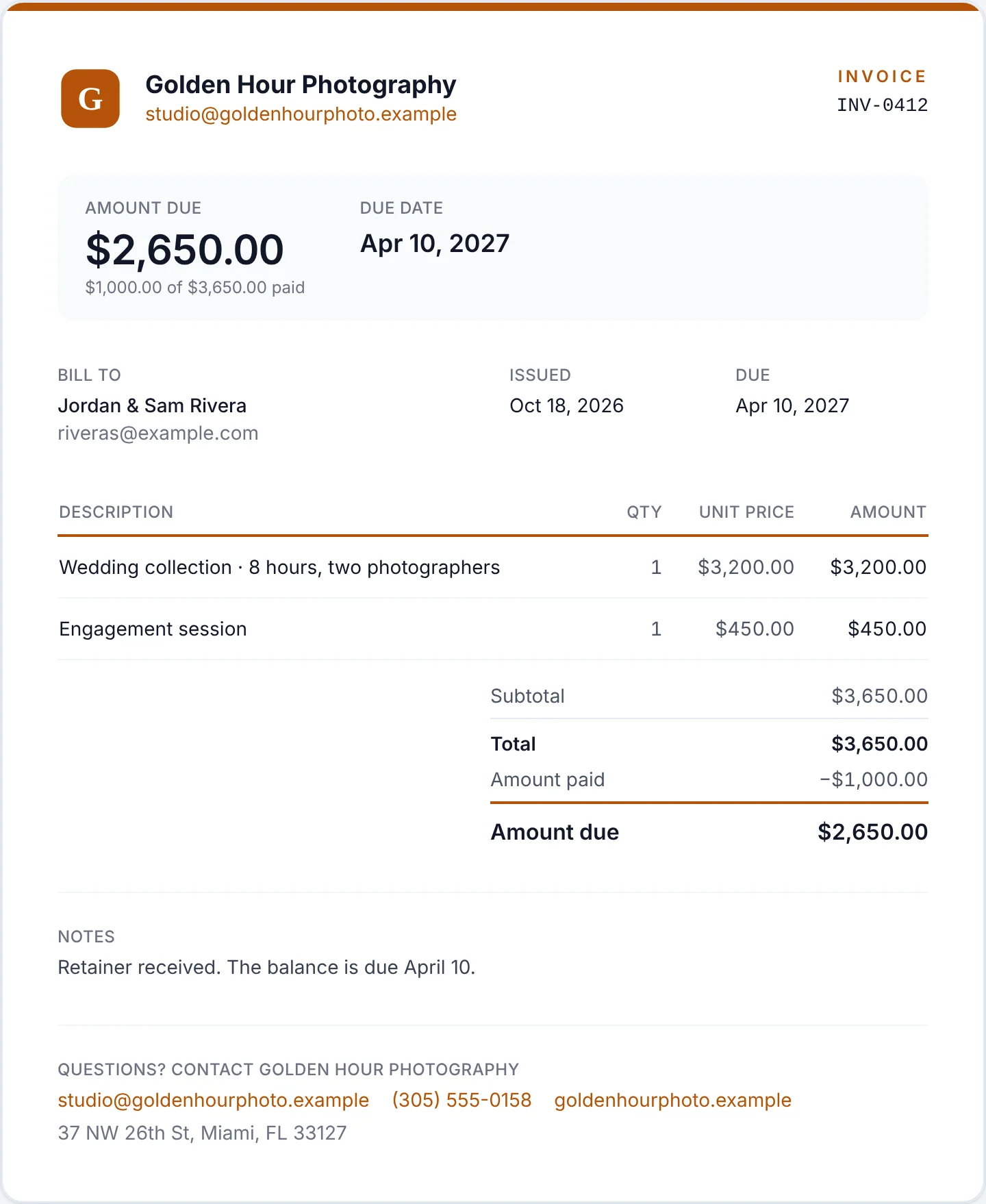
| Deposits or payments already received | Shows the balance actually due |
| How to pay, with a payment link | Removes the last reason to put it off |
| The client's PO number, if they use one | Many larger clients cannot pay an invoice without it |
How do you create and send an invoice, step by step?
Most of the work happens before the invoice exists: agreeing the price, terms and any deposit with the client means the invoice only has to restate what both sides already accepted. From there, the order below gets an invoice out the day the work is done and paid with the fewest follow-ups.
- Agree the price, payment terms and any deposit before the work starts, ideally on an accepted quote
- Create the invoice with the next invoice number, today's date and the due date
- Add each line item, then tax, discounts and any deposit already paid
- Turn on card and bank payment, and add the client's PO number if they use one
- Send it to the person who approves payments, with the pay link in the message
- Schedule reminders, then record the payment and send a receipt when it arrives
An invoice, from quote to paid
- 1
Quote
The client accepts the price and terms online.
Before the work - 2
Invoice
Sent with a pay link the day the work is done.
Day 0 - 3
Reminders
Before, on and after the due date.
Automatic - 4
Paid
By card, Apple Pay, Google Pay or bank, from the same page.
Card: seconds - 5
Reconciled
Receipt sent; the payment matched to its invoice in your books.
Closed
Which payment terms should you use?
Payment terms set when the invoice is due. Shorter terms get you paid sooner; longer terms are sometimes what a larger client's accounts team insists on. Agree them before the work starts and put them on every invoice.
| Term | Meaning | Typical use |
|---|---|---|
| Due on receipt | Payable as soon as it arrives | One-off jobs, new clients, small amounts |
| Net 15 | Due 15 days after the invoice date | Freelancers and small agencies |
| Net 30 | Due 30 days after the invoice date | The default for many business clients |
| Net 60 or Net 90 | Due 60 or 90 days after the invoice date | Large companies with fixed payment runs |
| 2/10 Net 30 | 2% off if paid within 10 days, otherwise due in 30 | Encouraging early payment |
When should you ask for a deposit?
Ask for a deposit when you will spend real time or money before the client sees the result: custom work, materials ordered in, events and bookings, and new clients you have not worked with before. A deposit also confirms the client is committed. Many businesses take a share up front and bill the balance on completion, or bill in milestones on long projects.
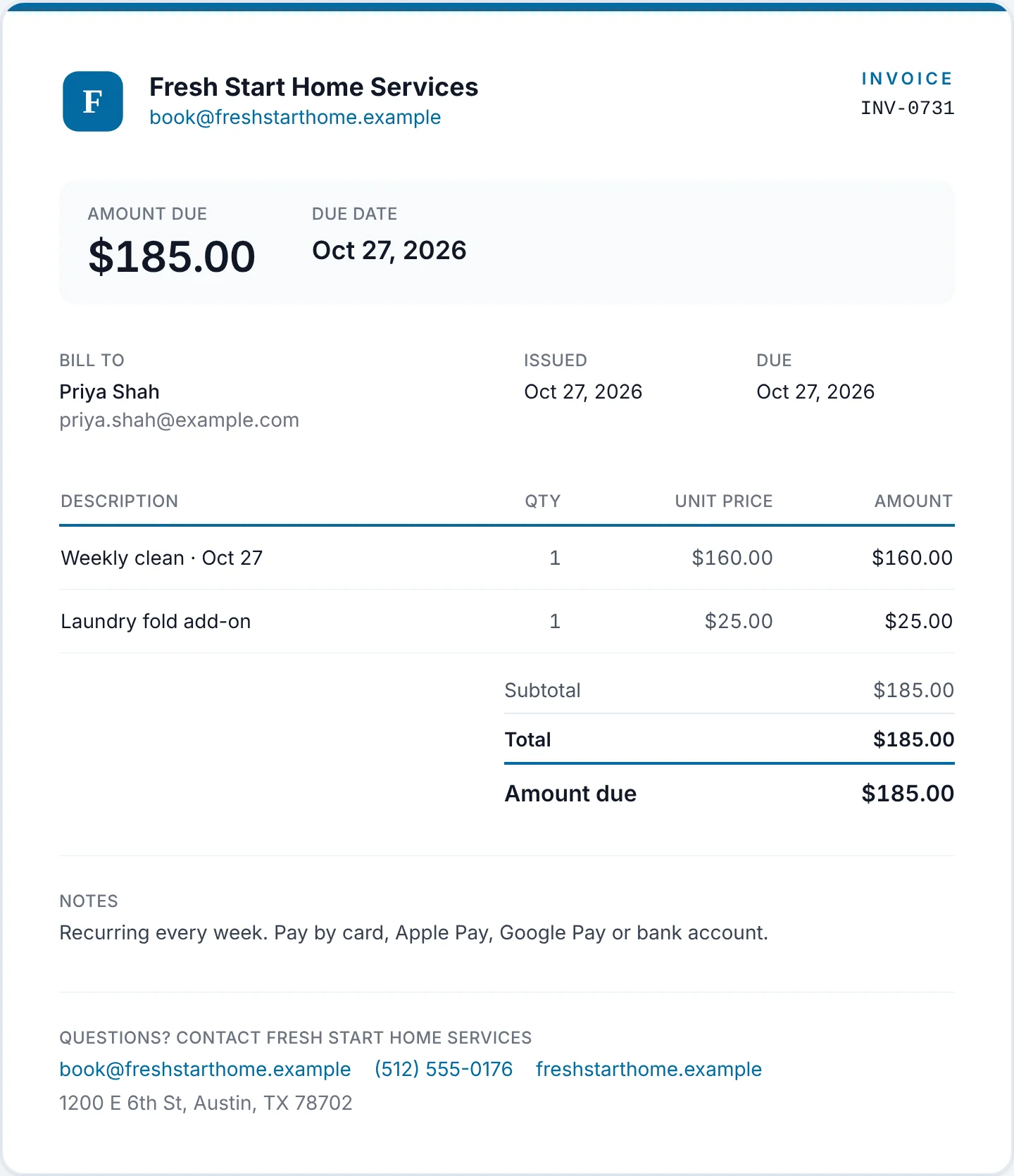
For ongoing work, such as a monthly retainer or service plan, a recurring invoice issued on a fixed schedule saves you sending the same invoice by hand every month.
Keep the deposit and the balance on one invoice where your tools allow it. The client sees one document with the total, what has been paid and what is still due, your books carry one receivable instead of two, and there is no second invoice for the client's accounts team to approve before the balance can be paid.
Invoice, quote, estimate, pro forma or receipt: which document when?
The documents look alike and do different jobs, and sending the wrong one is a common reason a client's accounts team sends something back. The test is simple: is the document asking for money, promising a price, or confirming a payment?
| Document | When you send it | Does it ask for payment? |
|---|---|---|
| Quote | Before the work, with a fixed price the client accepts | No; it becomes the invoice once accepted |
| Estimate | Before the work, when the final price may change | No |
| Pro forma invoice | Before delivery, often for customs or a client's internal approval | Sometimes, as a request for prepayment |
| Invoice | When payment is due | Yes, with terms and a due date |
| Recurring invoice | On a schedule, for retainers and ongoing services | Yes, each period |
| Receipt | After payment | No; it confirms the payment |
How do you get paid faster?
Most late payments are not refusals; they are invoices that were never easy to pay. Make paying the easiest thing the client can do today.
Offer both cards and bank payment. Cards are quick and familiar; bank (ACH) payments cost less on large amounts. On a $2,000 invoice, Stripe's published card rate of 2.9% + 30¢ is $58.30, while its ACH Direct Debit rate of 0.8%, capped at $5, is $5 (October 2026). Letting a business client choose ACH for big invoices keeps more of the money with you.
- Send the invoice the day the work is done, while it is fresh
- Put a pay button or link on the invoice so the client can pay in a minute
- Use short terms with new clients and deposits on large jobs
- Schedule reminders before, on and after the due date
- Make sure it reaches the person who approves payments, with any PO number they need
How should you handle late payments and late fees?
Start with a polite reminder a few days before the due date, another on the day, and firmer follow-ups after it. Most overdue invoices are paid after a reminder or two. If one is still unpaid weeks later, call the client: there is often a simple reason, such as a missing PO number or a change of contact.
Late fees or interest work only if the client agreed to them in advance, so put them in your contract and on the invoice. Some US states limit how much interest or what late fees a business can charge, so check the rules where you and your client operate. This is general information, not legal or tax advice.
How do you keep track of unpaid invoices?
With an accounts receivable aging report, which groups unpaid invoices by how long they are past due. Most accounting software produces one, and the buckets are standard, so the report tells you at a glance where your chasing time should go: an invoice ten days late needs a reminder, one ninety days late needs a decision.
Match every payment to its invoice number as it arrives, rather than in a monthly catch-up. Bank payments in particular can arrive with little detail, so ask clients to put the invoice number in the payment reference, and record partial payments against the invoice they belong to.
| Bucket | What it means | What to do |
|---|---|---|
| Current | Not yet due | Nothing beyond the scheduled reminder |
| 1–30 days past due | Recently missed | A reminder, then a friendly email or call |
| 31–60 days | Stalled | Call the approver; check for a missing PO number or a changed contact |
| 61–90 days | At risk | Pause new work and agree a payment plan in writing |
| Over 90 days | Unlikely to be paid without action | A final notice, then collections or small claims court |
Invoicing with Anytime Capital
Anytime Capital invoices carry your logo and brand colour, and the pay page can be served from a domain you own. Your client pays by card, Apple Pay, Google Pay or bank (ACH) from the same page, with no account or app on their side, and clients who pay in stablecoins can be sent a USDC or USDT payment request instead.
Choose due on receipt, Net 15, Net 30 or a date you pick; ask for a fixed or percentage deposit and collect the balance on the same invoice; set invoices to recur weekly, monthly, quarterly or yearly; and record cash, check or bank transfers paid offline. Reminders go before, on and after the due date, never more than one a day, and stop when the invoice is paid. Paid invoices can be in your Anytime Capital business account in seconds.
Frequently Asked Questions
What is the difference between an invoice, a quote and a receipt?
A quote or estimate is sent before the work and says what it will cost. An invoice is sent when payment is due and asks for it. A receipt is sent after payment and confirms it was received.
What does Net 30 mean on an invoice?
Net 30 means the full amount is due 30 days after the invoice date. Net 15 and Net 60 work the same way with 15 or 60 days. Due on receipt means payable as soon as the client gets it.
Do I need to charge sales tax on an invoice?
It depends on what you sell and where you and your client are. Many services are not taxed in many US states, while most physical goods are. Check with your state's tax agency or an accountant. This is general information, not tax advice.
How should I number my invoices?
Use a unique number for every invoice, usually sequential, such as 1001, 1002, 1003. Some businesses add a year or client prefix. Never reuse a number, even for a cancelled invoice: void it and issue a new one.
Can I invoice a client before the work is done?
Yes. A deposit invoice, a milestone invoice or a retainer invoice is sent before or during the work. Make clear on the invoice what it covers and what will be billed later.
How long should I keep copies of invoices?
Keep them with your business records for as long as your tax authority may ask for them. In the US the IRS generally asks for three years, and longer in some situations, so many businesses keep seven. Ask your accountant what applies to you.
Should I send an invoice as a PDF or as a link?
Send a link with a pay button, and make a PDF available too. The link lets the client pay the moment they open it, while the PDF suits accounts teams that file or forward documents. Anytime Capital invoices do both: the client gets a branded pay page and can download a PDF of the same invoice.
Can I add a card processing fee to an invoice?
Sometimes. Many states allow a disclosed surcharge on credit cards within the card networks' caps, never on debit cards, and Connecticut and Massachusetts ban credit card surcharges. Offering bank payment, or a small discount for paying by bank, is often the simpler way to cut card costs on large invoices. General information, not legal advice.
Keep reading
Important Disclosures
- Third-party fees and product details cited on this page are each company's published US pricing, or industry-typical ranges, as of the date shown and may have changed. Check current pricing with the provider before you decide.
- Information on this page is general and educational — it is not financial, legal, or tax advice.
- Anytime Capital is a fintech company, not a bank. Payment processing, banking and payout services are provided by Anytime Capital's licensed partners. Rates shown are for US card payments; international cards, currency conversion and disputes may carry additional fees shown in your dashboard before you accept a payment.