Answer
How long does it take to get crypto into your bank account?
Quick answer
Moving crypto to a bank account has two clocks: selling the crypto, which takes minutes once it is confirmed on-chain, and paying out the dollars. Payouts typically arrive in 1–3 business days by ACH, or the same business day by wire when sent before your bank's cutoff (2026).
Updated October 2026. Evergreen page — refreshed in place as facts change.
- Bitcoin block
- ~10 min
- Platforms often wait 1–3 blocks
- Solana
- Seconds
- Typical time to credit a deposit
- Tron (USDT)
- ~1 min
- 19 blocks of 3 seconds to finalize
- RTP / FedNow payout
- Seconds
- Where your bank is on the network
- Wire payout
- Same day
- Sent before the bank's cutoff
- ACH payout
- 1–3 days
- Business days, standard ACH
- Instant rail limit
- $10M
- RTP and FedNow network max, 2025
- Weekends
- Crypto runs
- Wires and ACH wait for Monday
How long it takes to transfer crypto to a bank account is really two questions with very different answers. The blockchain part — getting your coins to the platform that buys them — takes seconds on some networks and up to an hour on bitcoin. The banking part — getting the dollars from that platform to your bank — can take seconds over the instant rails, hours by wire, or a few business days by ACH. This page times both clocks, network by network and payout by payout, shows how they add up end to end, and lists the delays that have nothing to do with either: verification, compliance review, names that don't match and cutoffs.
Payment methods on this page
.svg) BitcoinCrypto
.svg) EtherCrypto
.svg) USDTMinutes · 24/7
- RTPSeconds · 24/7
- FedwireSame day · business days
- ACH1–3 business days
Why are there two waiting periods?
Because two different systems are involved. The crypto leg — moving coins to the platform and selling them — runs on blockchains that settle in seconds to minutes, around the clock. The dollars leg — getting the sale proceeds into your bank account — runs on bank rails, most of which move in business-day windows. Much of the time people attribute to 'crypto being slow' is actually the second clock: ordinary ACH settlement doing what ACH does.
Understanding the split tells you exactly where the time can be cut — and it is almost never on the blockchain side. Choosing a fast network saves minutes; choosing a fast payout rail can save days.
Crypto to your bank, step by step
- 1
Sell order
Pick the coin, the network and how you want to be paid.
A minute - 2
Send the crypto
To the deposit address made for that order, on that network.
You control - 3
Confirmations
The network confirms the transfer; the platform credits it.
Seconds–1 hour - 4
Sale and checks
The sale executes; verification and any review complete.
Minutes, if verified - 5
Payout sent
Dollars leave by RTP or FedNow, wire, ACH or SWIFT.
Your chosen rail - 6
Bank credits it
Your bank posts the payment to the account in your name.
Seconds to days
How long does the crypto leg take?
Confirmation time depends on the network you send over, not the coin's price or the amount. Each platform also sets how many confirmations it waits for before crediting a deposit, so the same network can credit faster at one platform than another:
| Asset / network | Block time | Typical time to credit | Notes |
|---|---|---|---|
| Bitcoin (BTC) | ~10 minutes | 10–30+ minutes (1–3 confirmations) | Block times vary; a slow block can take much longer |
| Ethereum (ETH, ERC-20 USDT and USDC) | 12 seconds | A few minutes | Full finality takes about 13 minutes |
| Solana (SOL, SPL USDT and USDC) | Under a second | Seconds | The fastest common path |
| Tron (TRX, TRC-20 USDT) | 3 seconds | About a minute | Final after 19 blocks |
| Litecoin (LTC) | ~2.5 minutes | 5–15 minutes | Platforms often wait several blocks |
How long does the bank payout take?
Once the sale is done, the rail you are paid on decides the rest. In 2026 the realistic options are:
- RTP or FedNow — seconds, at any hour, when your bank is on the network; both instant rails accept single payments up to $10 million at the network level, and each bank sets its own lower limit.
- ACH — typically 1–3 business days for a standard ACH credit, or the same business day with Same Day ACH. The fallback when a bank isn't reachable over an instant rail.
- Domestic wire — the same business day when sent before the bank's cutoff, on Fedwire, which runs on business days only.
- SWIFT wire — 1–5 business days for an international payout, depending on the correspondent banks in between.
- A local rail abroad — seconds to minutes on instant systems such as SEPA Instant, Faster Payments, PIX, SPEI and UPI, in the local currency.
| Payout | Typical arrival | Runs | Reversible? |
|---|---|---|---|
| RTP / FedNow | Seconds | 24/7/365 | No — final once sent |
| Domestic wire (Fedwire) | Same business day | Business days, before cutoff | No — final once settled |
| Same Day ACH | Same business day | Business days, three windows | Returnable in defined cases |
| Standard ACH | 1–3 business days | Business days | Returnable in defined cases |
| SWIFT wire | 1–5 business days | Business days, both countries | Recall is only a request |
| Local instant rail abroad | Seconds to minutes | Mostly 24/7 | Generally final |
How long does it take end to end?
Put the two clocks together and the route you pick matters far more than the coin. A stablecoin on a fast network paid out over an instant rail can reach a bank account in about the time it takes to make coffee; the same sale paid out by ACH spends days on the bank side. These are typical totals once your account is verified:
From sending crypto to dollars in the bank
- USDC on Solana, RTPAbout a minute
- USDT on Tron, RTPA few minutes
- Bitcoin, RTP30–60 minutes
- Any coin, wireSame business day
- Any coin, ACH1–3 business days
- Any coin, SWIFT1–3 business days+
Do weekends and holidays delay crypto-to-bank transfers?
The crypto leg doesn't notice weekends — blockchains confirm at 3 a.m. on a Sunday exactly as they do on a Tuesday afternoon. The bank leg does, unless the payout rides an instant rail. Fedwire and ACH settle on business days only and observe the eleven Federal Reserve holidays, so a Saturday sale paid by wire or ACH starts moving on Monday. RTP and FedNow run every day, so they are the only bank rails that can deliver a weekend payout — subject, as always, to the platform's own processing and review.
When each leg can move, across a week
Crypto deposit
Any network
RTP / FedNow
Instant payout
Wire payout
Fedwire
ACH payout
Settlement windows
Why do crypto payouts get delayed?
Six causes account for nearly every delayed payout we see, and only the first one has anything to do with the blockchain:
- The deposit hasn't reached the platform's confirmation threshold yet — common on bitcoin when blocks are slow or the sending fee was low.
- The coins were sent on a different network from the one the order asked for, so they never arrived where expected.
- Account verification is incomplete; a regulated platform cannot pay out until it is finished.
- The transaction is held for routine compliance review, which regulated platforms are required to perform under the Bank Secrecy Act, particularly on large or first-time cash-outs.
- The payout account isn't in your name, or the name doesn't match closely enough — payouts go only to accounts held by the verified seller.
- The payout was requested after the day's wire cutoff or ACH window, or the receiving bank isn't on an instant rail and the payment went by ACH instead.
How do you make it faster?
From the reviewing side, the pattern is consistent: completed verification before you sell, and prompt plain answers to any follow-up question, keep the total time to 'blockchain minutes plus bank rail', with nothing added. In order of impact:
- Verify your account fully before the day you need money — verification is the only step that can add days, and it is entirely front-loadable.
- Choose an instant payout where your bank supports RTP or FedNow; otherwise a morning wire beats ACH by days.
- Use a fast network for the deposit — USDT over Tron or USDC over Solana clears in seconds to a minute; a bitcoin deposit needing several confirmations is the slowest common path.
- Mind the cutoffs — a wire requested at 4:55 p.m. ET is tomorrow's wire at most banks; morning requests settle same-day.
- Pay out to an account in your own legal name, with the name entered exactly as the bank holds it.
- For large amounts, talk to a desk first — OTC handling with pre-agreed settlement beats discovering a review hold mid-transfer; that's what our OTC desk is for.
How long does it take with Anytime Capital?
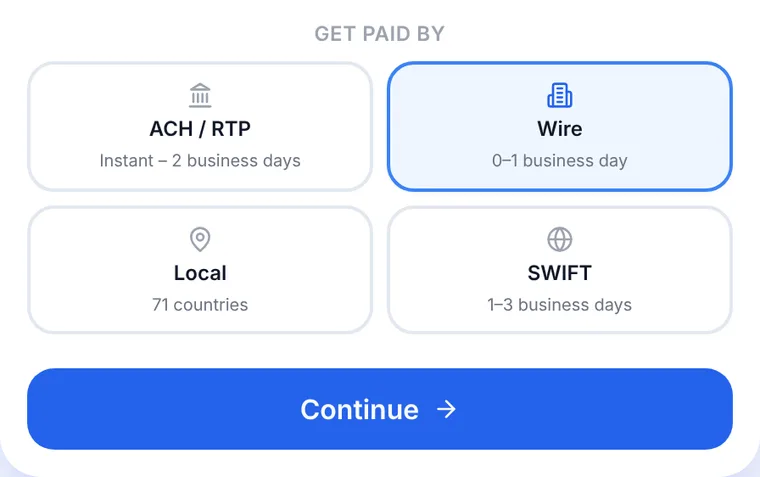
On Anytime Capital you open a sell order for bitcoin, ether, Solana, Litecoin, TRON or the stablecoins USDT, USDC and DAI, choose how you are paid, and send the crypto to the deposit address made for that order — a fresh address every time. Once the deposit confirms and your account is verified, the payout goes to an account or wallet in your own name: ACH / RTP to a US bank (in seconds over RTP or FedNow where your bank supports it, otherwise by ACH), a domestic wire the same business day, a SWIFT wire elsewhere, or a local rail in 71 countries. Each option's typical timing is shown before you continue.
You can open the order and send the crypto while verification completes; the payout waits for it. Processing is subject to compliance review under our BSA/AML program, and our processing times page explains how each method behaves. Digital assets are not FDIC-insured deposits.
Do you owe taxes when you move crypto to a bank account?
Moving dollars from a platform to your bank is not a taxable event; selling the crypto to get those dollars usually is. In the US, a sale is a disposal of a digital asset, with a gain or loss measured against what you paid. Starting with 2025 sales, US brokers report gross proceeds to the IRS on the new Form 1099-DA, and from 2026 they add cost basis for assets acquired on the platform. Keep your own records of dates, amounts and transaction hashes either way. This is general information, not tax advice — talk to a tax professional who knows digital assets.
Frequently Asked Questions
Can I get crypto proceeds in my bank account the same day?
Yes. Choose an instant payout over RTP or FedNow if your bank is on one of those networks — it arrives in seconds — or a wire requested before the day's cutoff. A morning sale of a fast-network asset, wired out before cutoff, lands the same business day.
Why does my bitcoin deposit take 30 minutes but my USDT arrive in a minute?
Different blockchains. Bitcoin produces a block roughly every 10 minutes and platforms often wait for multiple confirmations; Tron finalizes in about a minute and Solana in seconds. The asset you sell — and the network you send it on — sets the first clock.
Do weekends delay crypto-to-bank transfers?
The crypto leg doesn't notice weekends — you can sell any hour of any day. The bank leg does: ACH and wires only move on business days, so a Saturday sale paid that way arrives from Monday. RTP and FedNow run every day, which makes them the weekend option where your bank supports them.
How long do large cash-outs take?
Larger and first-time cash-outs can add a compliance review step at any regulated platform — the Bank Secrecy Act requires it. With verification complete and questions answered promptly, most reviews resolve quickly; for six-figure amounts, arranging the trade through an OTC desk beforehand is the smoothest path.
Why did my payout arrive by ACH when I chose ACH / RTP?
RTP and ACH use the same routing and account numbers, so the payout rides an instant rail only when your bank can receive one. If it isn't on RTP or FedNow, the same payout goes by ACH and takes business days instead of seconds.
Can I send crypto directly to my bank account?
No — banks hold dollars, not tokens. The crypto has to be sold first, by a platform, exchange or desk, and the dollars then travel to your bank over a bank rail. Sending coins to anything other than a crypto address can lose them.
Can I be paid to someone else's bank account?
Not at a regulated platform. Payouts go only to an account held in the verified seller's own name; a third-party payout is refused, and a name mismatch delays the payment while it is checked.
My crypto sale is pending — when should I worry?
Check the order status first: if the deposit is still confirming, it is the network; if it says verification or review, answer any question promptly. If nothing has changed after the second business day, contact support with the order number and transaction hash.
Keep reading
Important Disclosures
- Cryptocurrencies and stablecoins are not FDIC-insured deposits, are not bank guaranteed, and can involve risk, including possible loss of value.
- Cryptocurrency transactions are irreversible once confirmed. Verify all details before sending.
- Additional identity verification may be required depending on transaction type and amount.
- Third-party fees, timings, and product details cited on this page are industry-typical figures as of the date shown and may have changed. Verify current details with the relevant institution.
- Anytime Capital is a licensed money services business. Information on this page is educational and is not financial, legal, or tax advice.